In the realm of high – speed data transmission for industrial cameras, Camera Link cables play a pivotal role. As a trusted Camera Link cable supplier, I’ve had the privilege of serving a diverse range of industries, each with its unique set of requirements. This has led me to delve deeply into the construction nuances of Camera Link cables tailored for different applications. Camera Link Cable

I. Understanding Camera Link Technology
Before delving into the construction differences, it’s essential to understand the basics of Camera Link. Camera Link is a standard for high – speed data transfer between industrial cameras and frame grabbers. It offers high bandwidth, reliability, and flexibility, making it ideal for applications such as machine vision, medical imaging, and surveillance.
The Camera Link standard defines different configurations, including Base, Medium, Full, and Extended. These configurations vary in terms of the number of data lanes, clock signals, and control signals, which in turn affect the bandwidth and data transfer capabilities of the system.
II. Construction Basics of Camera Link Cables
A typical Camera Link cable consists of multiple twisted pairs of wires, a shield, and an outer jacket. The twisted pairs are used to transmit data, clock, and control signals. The shield helps to reduce electromagnetic interference (EMI) and crosstalk between the different signal pairs, ensuring reliable data transmission. The outer jacket provides mechanical protection to the cable.
The choice of materials for each component is crucial. For the conductors, copper is the most commonly used material due to its excellent electrical conductivity. The insulation material should have good dielectric properties to minimize signal loss. Polyethylene and polyvinyl chloride (PVC) are popular choices for insulation.
III. Construction Differences Based on Application Requirements
A. Machine Vision Applications
Machine vision is one of the most common applications of Camera Link cables. In this field, high – speed and accurate data transfer is of utmost importance.
-
Bandwidth Requirements
Machine vision systems often require high – resolution images to be transferred at high frame rates. For example, in a high – speed assembly line inspection, the camera needs to capture and transfer thousands of images per second. To meet these high – bandwidth requirements, Camera Link cables used in machine vision applications are usually constructed with a greater number of data lanes. Full or Extended Configuration Camera Link cables are often preferred, as they offer more data paths and higher bandwidth compared to Base or Medium Configuration. -
Signal Integrity
Signal integrity is critical in machine vision to ensure accurate image data transfer. To minimize signal distortion and crosstalk, the twisted pairs in the cable are carefully designed. The twist ratio of the pairs is optimized to reduce electromagnetic coupling between adjacent pairs. In addition, high – quality shielding materials are used. A double – shielded design, consisting of an inner foil shield and an outer braided shield, is often employed to provide better EMI protection. -
Flexibility and Durability
In some machine vision setups, the camera may need to move or be repositioned frequently. Therefore, the Camera Link cable needs to be flexible and durable. A thinner outer jacket made of flexible materials such as TPE (thermoplastic elastomer) can be used to enhance flexibility. At the same time, the inner construction should be able to withstand repeated bending and mechanical stress. Some cables are designed with a special strain – relief mechanism at the connectors to prevent damage to the internal wires.
B. Medical Imaging Applications
Medical imaging applications, such as X – ray, MRI, and ultrasound, also rely on Camera Link cables for data transfer. However, the requirements in this field are somewhat different from those in machine vision.
-
Electromagnetic Compatibility (EMC)
In a medical environment, there are many sensitive electronic devices. Camera Link cables used in medical imaging need to have excellent electromagnetic compatibility to avoid interfering with other medical equipment. This requires a more rigorous shielding design. In addition to the double – shielded structure, some cables may use a special shielding material with high attenuation properties to reduce the electromagnetic radiation emitted by the cable. -
Safety and Hygiene
Medical applications demand high levels of safety and hygiene. The outer jacket of the Camera Link cable should be made of a material that is easy to clean and disinfect. PVC is a common choice as it is smooth, non – porous, and can be easily wiped clean. Moreover, the cable should comply with relevant medical safety standards, such as UL (Underwriters Laboratories) and CE (Conformité Européene) certifications. -
Reliability and Redundancy
In medical imaging, reliable data transfer is crucial for accurate diagnosis. To ensure reliability, some Camera Link cables used in medical applications may incorporate redundant data paths. This means that if one data lane fails, the system can still transfer data through the remaining lanes, reducing the risk of data loss.
C. Surveillance Applications
Surveillance systems are widely used for security monitoring in various environments, including public places, commercial buildings, and industrial facilities.
-
Long – Distance Transmission
Surveillance cameras are often installed in large areas, requiring the Camera Link cable to support long – distance data transmission. To minimize signal loss over long distances, the cable is constructed with lower – resistance conductors. Thicker copper wires are used to reduce the resistance, and the insulation material is carefully selected to have low dielectric constant and loss tangent. -
Environmental Resistance
Surveillance cameras may be exposed to various environmental conditions, such as extreme temperatures, humidity, and sunlight. The Camera Link cable needs to be able to withstand these harsh conditions. An outer jacket made of UV – resistant and weather – proof materials, such as polyurethane, can be used to protect the cable from the elements. In addition, the cable may be designed to have a high level of water resistance, using gel – filled or air – core designs to prevent water ingress. -
Cost – Effectiveness
In surveillance applications, cost is also an important consideration. While maintaining the necessary performance, the cable should be cost – effective. Manufacturers may optimize the cable construction by using less expensive but still reliable materials and reducing unnecessary features.
IV. Construction Adaptations for Specialized Requirements
In addition to the above – mentioned common applications, there are also some specialized requirements that may lead to further construction differences.
A. High – Temperature Environments
In some industrial applications, such as metal smelting or high – temperature processing, the Camera Link cable needs to operate in high – temperature environments. In this case, the insulation and outer jacket materials need to have high – temperature resistance. Materials such as fluoropolymers, which can withstand temperatures up to 200°C or higher, are often used. The conductors may also be coated with a heat – resistant layer to prevent oxidation and degradation.
B. High – Vibration Environments
In applications where there is a lot of vibration, such as on moving vehicles or in industrial machinery, the cable needs to be able to resist mechanical shocks. The cable construction may include additional reinforcement layers, such as Kevlar or fiberglass, to enhance the mechanical strength. The connectors are also designed to be more robust and have a better locking mechanism to prevent disconnection due to vibration.
V. Connecting with Customers
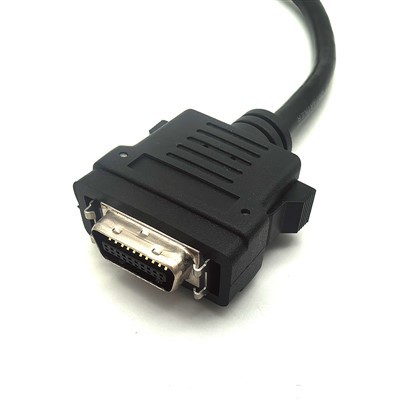
As a Camera Link cable supplier, I understand the importance of providing customized solutions to meet the specific needs of different applications. Whether you are in the machine vision, medical imaging, surveillance, or other industries, I am committed to offering high – quality Camera Link cables with the right construction for your requirements.
Camera Link Cable If you are looking for reliable Camera Link cables for your project, I would be more than happy to discuss your needs in detail. Our team of experts can provide technical support and guidance to help you select the most suitable cable. We can also offer samples for testing and evaluation. Don’t hesitate to reach out for a consultation and start the procurement process.
References
- Camera Link standard documentation provided by the Automated Imaging Association (AIA).
- Technical papers on high – speed data transmission cables in industrial applications.
- Industry reports on the development and application of Camera Link technology.
Karobert Technology LLC Karobert Trading PTE. LTD.
We’re known as one of the most professional camera link cable manufacturers and suppliers in China, also support customized service. Please feel free to buy high quality camera link cable made in China here from our factory. For price consultation, contact us.
Address: 6250 S 196th St, Kent, WA, 98055, USA.
E-mail: karl@karobert-us.com
WebSite: https://www.karobert-us.com/
