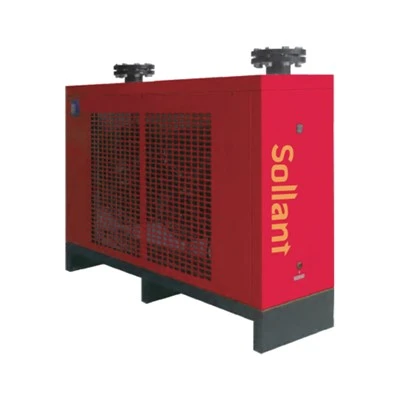
If you’ve ever spent time in industrial facilities, you’ve probably heard the familiar hissing of compressed air hoses powering everything from paint sprayers to automated assembly lines. What you might not think about is the quiet work happening behind the scenes to keep that air dry: a refrigerated air dryer. As a supplier of these systems, I get asked this question all the time: how does flow rate actually impact the performance of a refrigerated air dryer? It’s not a simple yes-or-no answer, and getting it wrong can lead to everything from damaged equipment to unexpected downtime—so let’s break this down like we do with our clients on our shop floor. Refrigerated Air Dryer

First, let’s define the basics for anyone who’s new to compressed air systems. A refrigerated air dryer works by cooling wet compressed air to a low temperature (usually around 3°C to 10°C, depending on the model) to condense water vapor into liquid, which is then removed via a drain. Flow rate here refers to the volume of compressed air the dryer can process in a given period, measured in standard cubic feet per minute (SCFM) at specific pressure and temperature conditions. Think of SCFM as the “throughput” of your system: if your production uses 100 SCFM of compressed air, your dryer needs to handle that same volume to keep up.
Here’s where the connection gets tricky. Every refrigerated air dryer is engineered with a specific rated SCFM capacity—let’s call that its design point. When you operate the dryer at that exact flow rate, it’s working as intended: the air spends just enough time inside the dryer’s heat exchanger to cool down to the target dew point, and all the condensed moisture is removed efficiently. But push that flow rate above the design point, and suddenly problems pop up.
I saw this firsthand last year with a small automotive parts shop they reached out to us about. They had a dryer that was rated for 150 SCFM, but they’d expanded their paint line and were now drawing 180 SCFM. Within a month, they were noticing water spots on their finished parts, which meant their compressed air wasn’t dry enough. What was happening? At flow rates 20% above the dryer’s design capacity, the compressed air was moving through the heat exchanger too fast. There wasn’t enough residence time—the time the air spends in contact with the cold coils—to cool down to the required temperature. A few degrees might not sound like much, but it’s enough to leave more water vapor in the air; instead of condensing out, it passes through the dryer and ends up in their supply lines.
On the flip side, running a dryer well below its rated flow rate isn’t always better either. I worked with a food processing plant a while back that had two dryers: one for their main production line (300 SCFM) and a smaller, leftover 100 SCFM dryer they’d installed to cover a new packaging machine that only used 40 SCFM. They were fine for the first few months, then they started getting algae growth in their air lines. Why? When flow is too low, the compressed air inside the dryer’s system doesn’t move enough to carry away condensed moisture. The excess water sits in the drain pan and the heat exchanger, creating a perfect breeding ground for bacteria and mold. Even worse, the dryer’s refrigerant cycle can become unstable at low flow rates—refrigerant might not circulate properly, leading to inefficient cooling and higher energy use.
So what’s the sweet spot? That’s where we come in as suppliers, because it’s not just about matching SCFM on paper. We have to consider your actual load profile, not just the peak flow rate. Many facilities have variable demand: sometimes they use 50 SCFM, sometimes 150, depending on the shift. A fixed-capacity dryer will struggle here, which is why we recommend modular or variable-speed drive (VSD) dryers for these applications. VSD dryers adjust their cooling capacity to match the actual flow rate, so whether you’re running at 30% or 100% of rated SCFM, you still get the required dew point.
Wait, let’s talk about dew point for a second, because that’s the ultimate measure of dryer performance. Dew point is the temperature at which water vapor condenses out of air; for industrial applications, a pressure dew point (PDP) of 2°C to 10°C is standard, depending on the use. When flow rate is too high, the PDP rises—meaning the air is still too moist. When flow is too low, the PDP might drop lower than needed, but that comes with energy waste. We had a client in the pharmaceutical industry once who insisted on a lower PDP than required, so they oversized their dryer and ran it at 40% flow. They ended up paying 30% more in electricity costs than necessary, just for a dew point that didn’t improve their product quality at all.
Another factor that’s easy to overlook: inlet air temperature. A lot of people forget that flow rate and inlet temperature work together. If your compressed air coming into the dryer is hotter, you need more residence time to cool it down. So a dryer rated for 150 SCFM at 38°C inlet air will only handle 130 SCFM if inlet air is 50°C. That’s a common mistake when clients don’t measure their inlet temperature correctly. We always do a site assessment first when we quote a dryer—we check not just peak flow rate, but also inlet temperature, pressure, and how demand varies throughout the day.
Let me break this down with a real example from another client, a woodworking shop that uses compressed air to power nail guns and sanders. They were having issues with rust on their air tools, so they bought a 200 SCFM dryer without checking their actual use. Their peak flow was only 120 SCFM, but their inlet air ran at 45°C in the summer. The 200 SCFM dryer was too big for their demand, so it was cycling on and off constantly, leading to unstable refrigerant pressure. In the summer, the high inlet temperature meant the dryer couldn’t cool the fast-moving air enough, so they still had moisture in their lines. We replaced it with a 150 SCFM VSD dryer, and adjusted the settings to match their 120 SCFM peak load. They stopped having rust on tools, and their energy bill went down 25%—that’s the kind of win we aim for.
So why does this relationship matter so much? Let’s list the consequences of getting it wrong: first, product damage. For automotive parts, paint defects; for food, contamination; for electronics, corrosion. Second, equipment failure. Moisture in compressed air can cause valves to stick, pipelines to corrode, and pneumatic tools to break. Third, higher operating costs. Either you’re wasting energy on an oversized dryer, or you’re paying for repairs because an undersized dryer is working too hard.
As a supplier, we don’t just sell dryers—we help clients match the right model to their specific flow rate needs. That means asking questions: What’s your average and peak SCFM? How does demand change day to day, or shift to shift? What’s the temperature of your inlet air? What’s the dew point requirement for your application? A small machine shop might just need a fixed-capacity dryer sized for their peak flow, while a large manufacturing plant with variable demand needs a VSD model. A food processing plant might need a dryer with a drain that prevents bacterial growth, so we factor in low-flow performance there too.
I always tell clients that flow rate isn’t just a number on a spec sheet. It’s the heart of how your dryer performs too much, too little, or just right. An undersized dryer will leave you with too much moisture, an oversized one will leave you with higher bills and unstable operation. The key is to get an accurate picture of your compressed air demand, not just pick a dryer with the highest SCFM rating.
If you’re currently dealing with moisture issues in your compressed air lines, or you’re not sure if your dryer is sized correctly for your flow rate, we can help. We offer free on-site assessments to measure your actual load, inlet conditions, and dew point requirements. We work with all types of facilities, from small shops to large industrial plants, to find a refrigerated air dryer that balances performance, efficiency, and cost. Don’t let a flow rate mismatch cause downtime, product defects, or unnecessary expenses—reach out to us to discuss your needs today.
Nitrogen Generator References:
- Compressed Air and Gas Institute. (2020). Refrigerated Air Dryers: Design, Operation, and Application. CAGI Standards and Recommended Practices.
- OSHA. (2019). Compressed Air Systems Guidelines for Industrial Facilities. U.S. Department of Labor.
- Freeman, G. (2018). Optimizing Refrigerated Air Dryer Performance Through Flow Rate Matching. Industrial Hydraulics & Pneumatics Magazine, Vol. 72, Issue 4, pp. 34-38.
- ASME. (2021). Standard for Compressed Air Dryers (ANSI/ASME PTC 19.3-2021). American Society of Mechanical Engineers.
Shanghai Sollant Energy Saving Technology Co., Ltd.
As one of the most professional refrigerated air dryer manufacturers and suppliers in China, we’re featured by quality products and good service. We warmly welcome you to buy bulk advanced refrigerated air dryer from our factory. If you have any enquiry about cooperation, please feel free to email us.
Address: No.215, Songri Center, Beihongqiao, Jiading District, Shanghai, China
E-mail: info4@sollant.com
WebSite: https://www.sollanttreatment.com/
