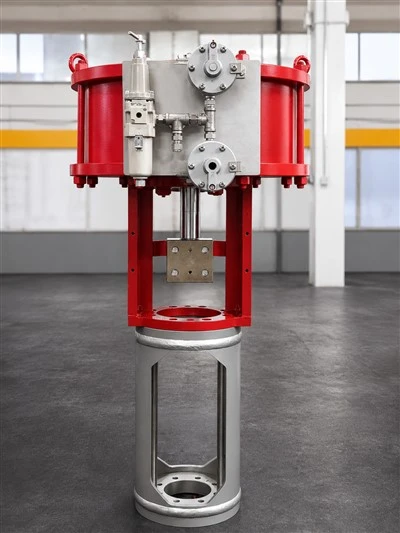
If you’ve ever stood in a refinery control room, watched a batch line toggle between open and closed in a fraction of a second, or waited for a valve in a power plant to trip safely during an emergency shutdown, you’ve been interacting with a Scotch Yoke Actuator. These devices are workhorses for industrial valve automation, turning pressurized air into the torque that opens and closes quarter-turn valves—think ball, butterfly, and plug valves—with precision and reliability. For 12 years, my company has supplied Scotch Yoke Actuators to facilities across North America, and one of the most common questions I get from new customers is: “How do I calculate the right air pressure for my application?” Scotch Yoke Actuator

It’s not a one-size-fits-all number, and skipping this step can lead to big problems: too little pressure leaves your valve sluggish, unable to overcome friction or load, while too much pressure wears out the actuator prematurely, leaks seals, or even damages the valve itself. Today, I’m breaking down the science behind calculating air pressure for Scotch Yoke Actuators, from the core torque formula to real-world adjustments I’ve learned from working with maintenance teams and process engineers every week.
First, let’s get clear on the core relationship here. A Scotch Yoke Actuator generates torque, and torque directly depends on two variables: the air pressure you supply, and the actuator’s design (specifically its bore size and scotch yoke mechanism dimensions). Your valve needs a specific amount of torque to operate, and that’s the anchor for all our calculations. Start here, not with pressure.
Most quarter-turn valves require a certain minimum break torque— the force needed to get the valve moving from a stationary position, after sitting in one state for hours. That number is higher than the running torque, the torque needed to keep the valve moving through its full 90-degree turn. You can find both values on your valve’s data sheet; if you don’t have one, the valve manufacturer can supply them. Skip that step, and your pressure calculation will be off before you even start.
Next, the basic formula for torque from a Scotch Yoke Actuator is simpler than it looks, but let’s define each term so there’s no confusion. The standard equation for linear force from pressurized air is F = P × A, where F is force in pounds (or newtons, if you use metric), P is air pressure in psi (or bar, if you prefer), and A is the effective area of the actuator’s piston in square inches (or square centimeters). But Scotch Yoke Actuators turn that linear force into torque via their scotch yoke assembly, which is the T-shaped mechanism that connects the piston to the valve shaft.
Torque (T) is then F multiplied by the effective length of the yoke arm (r), also called the yoke radius. So combining those gives T = P × A × r. That’s the core formula. Rearranged to solve for pressure (the number we’re after), that becomes P = T / (A × r). But wait—this is the theoretical pressure, and real-world applications almost never work perfectly like the lab formula. That’s where my 12 years of on-the-ground experience comes in.
Let’s walk through an example to make this concrete. Suppose we have a 3-inch butterfly valve for a water treatment application. Its valve data sheet says break torque is 2,000 in-lbs (inch-pounds) and running torque is 1,500 in-lbs. Our actuator is a double-acting Scotch Yoke, which means it uses pressure on both sides of the piston to open and close the valve. For this size valve, we’d select an actuator with a 4-inch bore piston (that’s the circular part that moves back and forth inside the actuator housing) and a yoke arm length of 2 inches. Let’s run the numbers first.
First, calculate the piston area. For a circular piston, area is π × (diameter / 2)². So for a 4-inch bore, that’s 3.1416 × (4 / 2)² = 3.1416 × 4 = 12.566 square inches. Now, using the break torque to find the minimum required pressure: P = 2,000 in-lbs / (12.566 sq-in × 2 in) = 2,000 / 25.132 ≈ 79.6 psi. So theoretically, 80 psi should give us enough torque to break the valve free. But here’s the catch: that number doesn’t account for real-world losses.
Any industrial application has friction: the valve’s stem packing, the seal inside the actuator, even the small amount of play in the yoke mechanism. In our example, those friction losses typically add 20 to 30 percent to the required pressure. For water applications, which have relatively low resistance, I usually add 25 percent as a safe buffer. So 79.6 psi × 1.25 = ~99.5 psi, or roughly 100 psi. That’s close to the standard 100 psi shop air pressure most facilities use, but I’ve seen plenty of cases where it’s not.
Let’s adjust for a more demanding application: a 6-inch ball valve on a crude oil pipeline. Its break torque is 12,000 in-lbs, running torque is 9,000 in-lbs. The actuator here has a 6-inch bore piston and a yoke arm length of 3 inches. Theoretical pressure for break torque is 12,000 / (π × 3² × 3) = 12,000 / (84.823) ≈ 141.5 psi. Now, this is a process valve in a hazardous area, so friction is higher—stem packing is tighter, the valve may have built up pressure from product sitting in the line. I add a 40 percent buffer here, so 141.5 psi × 1.4 = ~198 psi. That means this application needs a specialized air system that can supply up to 200 psi, which is common in oil and gas facilities but not standard. Cutting corners here would lead to the valve failing to trip during an emergency, which is not a risk anyone wants to take.
But wait—double-acting vs. spring-return actuators. That’s another key point I see new customers mix up. Double-acting actuators need pressure on both sides to open and close, so their pressure calculation is straightforward as we did above. Spring-return actuators, on the other hand, use one side for air pressure and the other side for a large spring that provides torque for the fail state. For spring-return units, you have two pressure values to calculate: the air pressure needed to open the valve, and the air pressure needed to close the valve (or activate the fail state). Let’s make that clear, because miscalculating this is one of the most common mistakes I help customers fix.
Take a spring-return Scotch Yoke Actuator for a 4-inch plug valve with a break torque of 5,000 in-lbs. The actuator has a 5-inch bore piston, yoke arm length 2.5 inches, and a spring that provides 3,500 in-lbs of torque. First, calculate the pressure needed to open the valve: this is when air pressure is on the side opposing the spring, so we need the net torque from air minus spring torque to be at least the valve’s break torque. So air torque = valve break torque + spring torque = 5,000 + 3,500 = 8,500 in-lbs. Pressure = 8,500 / (π × (2.5)² × 2.5) = 8,500 / 49.087 ≈ 173 psi. That’s higher than double-acting would need for the same torque, but it’s because the spring is working against us. Now, for the fail-close state (assuming this is a fail-close valve), air pressure is on the spring side, so we need air torque plus spring torque to be enough to close the valve. If the valve’s break torque for closing is 4,500 in-lbs, then net torque needed is 4,500 in-lbs, so air torque is 4,500 – 3,500 = 1,000 in-lbs. Pressure = 1,000 / 49.087 ≈ 20.4 psi. So that application only needs ~20 psi to keep the valve closed during normal operation, and ~175 psi to open it. I always remind customers here: don’t size the air system for the low pressure, size it for the highest pressure requirement, which is almost always the open torque for spring-return units.
Now, what about side loads? That’s another factor that’s easy to overlook. Side loads are forces applied perpendicular to the valve stem, common in high-pressure pipelines, where the line’s pressure pushes against the valve disc. For every 100 psi of line pressure, you can expect about 100 lbs of side load force per inch of valve diameter. So a 6-inch valve at 1,000 psi line pressure has a side load of 6,000 lbs, which adds significant friction to the valve’s operation. Let’s adjust our earlier 6-inch ball valve example: that valve had a break torque of 12,000 in-lbs at 0 line pressure, but at 1,000 psi line pressure, its actual break torque jumps to about 18,000 in-lbs. That changes everything—our theoretical pressure would jump to 18,000 / 84.823 = ~212 psi, plus our 40 percent buffer brings it to ~297 psi. Suddenly, this application needs a much higher pressure system, and a larger actuator than we initially thought. I work with engineering teams all the time to calculate side load correction factors, and I always say: never use the valve’s standard torque rating without adjusting for process pressure and side loads. A valve that works at 0 psi line pressure may not work at full operating pressure, and that’s a mistake that leads to unplanned downtime.
What about common pitfalls? Let’s run through the ones I see most often. First, using the valve’s running torque instead of break torque. Running torque is for when the valve is moving, but break torque is what you need to get it started. If you use running torque, you’ll get a pressure that’s too low, and the valve will chatter or fail to open after sitting overnight. Second, not accounting for altitude or temperature. Air density decreases at high altitude, so at 5,000 feet above sea level, 100 psi at the compressor is equivalent to about 92 psi at the actuator. High temperatures can also reduce air pressure, because air expands in the lines—if your air lines run through a 120-degree process area, you might lose 5 to 10 psi between the compressor and actuator. Always adjust pressure for ambient conditions. Third, ignoring valve stick-slip. That’s when the valve sits for a long time, and the disc sticks to the seat, requiring much more force to break free. For valves that cycle less than once a day, add an extra 15 to 20 percent to your pressure buffer to account for stick-slip.
Let’s also talk about safety factors, which I can’t emphasize enough. Theoretical numbers are just that—numbers on a page. I always recommend a minimum safety factor of 1.2, and for critical applications like emergency shutdown (ESD) valves, go to 1.5 or even 2. A 1.5 safety factor means you multiply your required torque by 1.5 before calculating pressure, which accounts for unforeseen friction, line pressure, or wear over time. I had a customer a few years back who used a 1.0 safety factor for a flare valve, and during an ESD event, the valve only generated 85 percent of the required torque, leaving the valve partially open and creating a safety hazard. We re-sized their actuator and adjusted their pressure calculation to a 1.5 safety factor, and they’ve had no issues in the five years since.
Now, how do you verify this once you’ve calculated it? Once you’ve got a pressure number, test it. Bring the actuator and valve offline, run air at your calculated pressure, and check the torque output with a torque wrench or a pressure gauge connected to the actuator. I always do a field test before commissioning any system, because pipe thread friction, line pressure, and even minor actuator wear can throw off theoretical numbers. If the test shows you have 10 percent more torque than needed, that’s fine—just don’t go over the maximum operating pressure of the actuator. Every Scotch Yoke Actuator has a maximum pressure rating, usually 150 psi, 250 psi, or 300 psi for standard units. Never exceed that, even if your torque calculation says you need more—if you do, you’ll risk damaging the actuator housing, seals, or yoke.
For those who prefer metric units, the formula is identical, just adjust the units: torque in Newton-meters (Nm), piston area in square centimeters, yoke arm length in centimeters, pressure in bar. The same safety factors and buffer rules apply, regardless of unit system.
At the end of the day, calculating air pressure for a Scotch Yoke Actuator is all about balancing science and real-world application. The formula is simple, but getting it right requires knowing your valve, your process, and the environment your actuator will operate in. Over my 12 years in this business, I’ve seen customers cut corners on this step and end up with weeks of unplanned downtime, or oversize their actuators and waste thousands of dollars on unnecessary equipment. The sweet spot is using the right theoretical formula, adding realistic buffers for friction and application-specific factors, and verifying with on-site testing.
Hydraulic Actuator If you’re working on a new valve automation project, or troubleshooting an existing actuator that’s not performing as expected, I’m here to help. My team and I work with facilities of all sizes, from small water treatment plants to large oil refineries, to calculate the right air pressure, size actuators, and ensure your valves operate reliably for years. We don’t do one-size-fits-all solutions—every application has unique needs, and we take the time to walk through your specific torque requirements, process conditions, and safety standards to get it right. For any questions about Scotch Yoke Actuator pressure calculations, sizing, or replacement parts, don’t hesitate to reach out to our team to start a conversation about your project.
References
- ISA-75.01.01, “Control Valve Terminology,” International Society of Automation, 2020.
- “Scotch Yoke Actuator Design and Application Guidelines,” Manufacturers Standardization Society (MSS), 2018.
- Kerr, R., “Valve Actuation: Selection, Sizing, and Installation,” Elsevier, 2019.
- “Spring-Return vs. Double-Acting Actuators for Quarter-Turn Valves,” Process Industry Practices (PIP), 2021.
- “Side Load Effects on Quarter-Turn Valve Torque Requirements,” American Water Works Association (AWWA), 2020.
Zhejiang Bigtork Valve Automation Co., Ltd.
Zhejiang Bigtork Valve Automation Co., Ltd. is one of the leading scotch yoke actuator manufacturers and suppliers in China. We warmly welcome you to buy customized scotch yoke actuator at competitive price from our factory. Contact us for more details.
Address: 998 Yuanqu Avenue, Anfeng Industrial Zone, Oubei, Yongjia, Zhejiang, China
E-mail: sales@bigtork.com
WebSite: https://www.bigtork.com/
